
Cities are the engines of modern prosperity. They account for over 80 percent of global output. Yet the global urban landscape is marked by stark divergencies in wealth. Cities such as New York, London, Singapore, and Shenzhen generate levels of income and productivity comparable to advanced economies. While others like Mogadishu, Bujumbura, or Kinshasa struggle to provide basic services, let alone sustained economic opportunity. This divergence is one of the central puzzles of economic geography and political economy: why do some cities become extraordinarily rich while others remain stuck in poverty?
In this blog, we argue that cities become rich when they successfully organize density around productivity, and they remain poor when urban growth outpaces the institutions and economic structures needed to support productive employment. Infrastructure, human capital, and connectivity matter, but they are downstream of a more fundamental question. Can a city coordinate land, labor, capital, and firms toward scalable, high-value economic activity? Where that coordination succeeds, density becomes an asset. Where it fails, density becomes congestion.
At the heart of urban wealth lies productivity. Productivity is not simply about how hard people work; it is about how effectively labor, capital, and technology are combined. Rich cities are places where firms consistently generate high value per worker. This is made possible by agglomeration economies, dense concentrations of skilled labor, specialized suppliers, infrastructure, and knowledge spillovers that reduce transaction costs and accelerate learning by firms. Agglomeration lowers transaction costs and accelerates learning, enabling firms to specialize, innovate, and scale. Firms in rich metropolitan areas can be several times more productive than similar firms in low-income cities, even within the same sector. Once a city crosses this productivity threshold, growth becomes self-reinforcing. Firms attract talent and capital to finance further innovation and growth.
Shenzhen illustrates this dynamic vividly. In 1980 it was a peripheral fishing town of roughly 30,000 people. However, its transformation was not accidental. The city was deliberately positioned as an export-oriented manufacturing hub, supported by flexible land-use rules, infrastructure investment, and institutional experimentation within China’s special economic zone framework. Over time, it moved up the value chain from assembly to electronics, design, and innovation. Today it is home to globally competitive firms and one of the highest concentrations of patents in the world. Shenzhen’s wealth did not emerge organically; it was built through coordinated policy choices that aligned density with productive enterprise.
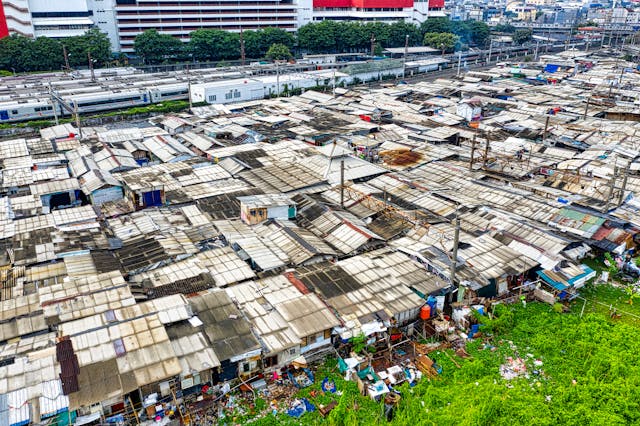
By contrast, many poor cities, are trapped in low-productivity equilibria. Their economies are dominated by informal services, petty trade, and low-value manufacturing activities that absorb labor but generate little learning, upgrading, or capital accumulation. In sub-Saharan Africa, for example, informal employment often accounts for over 70 percent of urban jobs, and the median firm employs fewer than five workers. In such environments, agglomeration produces congestion rather than productivity. Congestion imposes significant costs on both firms and workers creating persistent gridlocks that reduce mobility. These constraints generate inefficiencies lengthening commute times, fragmenting labor markets, increasing search hiring costs for firms. Firms remain small because they face unreliable power, insecure land tenure, weak contract enforcement, and limited access to long-term finance. Urbanization proceeds, but growth does not. Cities expand horizontally into informal settlements while productive employment stagnates.
The result is “urbanization without industrialization”, with large, young populations concentrated in cities that lack the firms, infrastructure, and institutions needed to employ them productively. This pattern is visible across much of Africa and parts of South Asia. Cities like Kinshasa or Lagos have grown rapidly, driven less by industrial opportunity than by rural distress and demographic pressure. People move to cities because agriculture no longer sustains livelihoods, not because urban labor markets are generating high-productivity jobs. The result is a large, young urban population concentrated in cities that lack the firms, infrastructure, and institutions needed to employ them productively.
It is important, however, to distinguish among different categories of poor cities. Some, like Mogadishu, are shaped by prolonged conflict and state collapse, where even basic governance functions are absent. Others, like Kinshasa or Dar es Salaam, exist within functioning states but suffer from chronic institutional weakness, fragmented authority, and limited fiscal capacity. While the symptoms may appear similar informality, congestion, underemployment, the policy challenges differ. Governance matters in all cases, but it operates under very different constraints.
History also matters, though it is not destiny. Many rich cities benefited from early integration into global trade, colonial-era infrastructure, or early industrialization, creating path dependence in investment and skills. Conversely, many poor cities inherited distorted economic structures, having been designed as administrative centers or extraction hubs rather than productive urban economies.
Yet history alone cannot explain contemporary divergence. What differentiates today’s rich from poor cities is not their starting point, but their capacity to adapt. Singapore exemplifies this canonical example. At independence, it faced severe housing shortages, high unemployment, and no natural resources. Its success lay in building institutions capable of planning land use, mobilizing revenue, enforcing rules, investment in infrastructure, and aligning education with industrial strategy. The state coordinated housing, transport, ports, and skills development around a clear vision of export-led growth. Governance, not geography, proved decisive.
Urban governance remains the most important contemporary determinant of city wealth. Rich cities are embedded in institutional environments that protect property rights, enforce contracts, and provide predictable rules for investment. Importantly, they can coordinate across sectors transport, housing, land, utilities, and regulation in ways that support firms and workers simultaneously. They densify without descending into chaos. Poor cities, by contrast, suffer from fragmented authority, insecure land tenure, and planning regimes that are either absent or unenforced. Infrastructure provision lags behind population growth, raising costs for firms and households alike.
Economic structure reinforces these outcomes. Wealthy cities host diverse and adaptable economies. When one sector declines, others expand. Over time, these cities move from routine production to innovation-intensive activities. Poor cities tend to be narrowly specialized often in tourism, low-end manufacturing, or resource-linked services sectors that are vulnerable to shocks and offer limited scope for upgrading. When these sectors falter, there are few alternatives.
Connectivity matters, but again, governance determines whether it pays off. Rich cities are integrated into global markets and national through ports, airports, and digital networks. Many poor cities are physically connected yet economically peripheral, participating in global value chains only at the lowest tiers. National policies often exacerbate these divides by concentrating investment and political attention in a single primate city while neglecting secondary cities that could otherwise become productive hubs.
Human capital deepens the gap, but it is not the starting point. Rich cities attract skilled workers and host universities and research centers, creating virtuous cycles of innovation. Poor cities struggle with underfunded schools, health challenges, and spatial segregation that traps residents in low-opportunity neighborhoods. Yet talent does not remain where firms cannot use skills productively. Jobs attract skills at least as much as skills attract jobs.
The implication is uncomfortable but necessary; urban poverty is not primarily a failure of people, but of systems. The residents of poor cities are often as entrepreneurial and ambitious as those in rich ones. What they lack is an enabling environment secure land tenure, reliable infrastructure, predictable rules, and access to productive firms. Conversely, urban wealth is not guaranteed. Detroit and Liverpool remind us that when governance fails to adapt to structural change, even prosperous cities can decline.
Cities are not natural outcomes of market forces; they are political and policy constructs. Decisions about land, infrastructure, taxation, decentralization, and industrial policy shape urban trajectories for decades. Some cities are rich because they made, or inherited and sustained, choices that favored productivity and adaptability. Others are poor because urban growth was treated as a demographic problem rather than an economic opportunity.
The lesson is clear. Cities become rich when they align density with productivity, growth with governance, and openness with economic upgrading. They remain poor when urbanization outpaces institutions, when economies fail to diversify, and when policy prioritizes shelter and subsistence over firms and jobs. In an urbanizing world, prosperity will not be decided by how fast cities grow, but by whether they are deliberately built to produce.
Blog-authored by the Centre for Economic Policy and Development Impact Evaluation (CEPDIME). Generating evidence for policy action.