
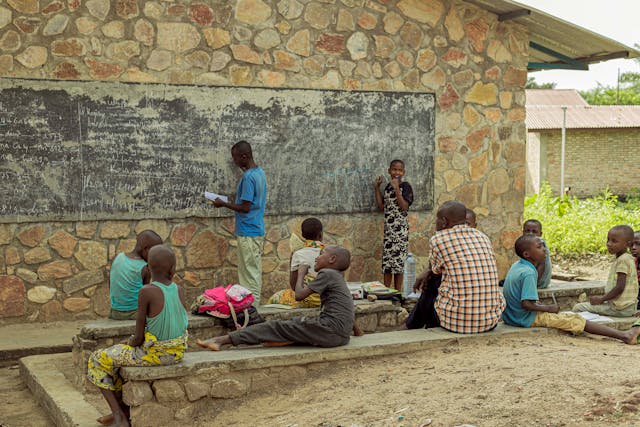
Education remains one of the most powerful engines of human and individual empowerment, social mobility, and long-term economic growth. By building cognitive skills, technical competencies, and socio-emotional capabilities, education enhances productivity, stimulates innovation, and strengthens civic participation.
Africa’s long-term growth trajectory will be determined less by its natural resource endowment and more by its human capital accumulation. With the world’s youngest population and a rapidly expanding labor force, the continent faces a demographic inflection point: education systems must transform rapidly to convert demographic expansion into a productivity dividend. If learning outcomes remain weak and labor market alignment insufficient, demographic growth risks translating into unemployment, informality, and social fragility rather than sustained economic transformation.
Over the past two decades, Africa has achieved major gains in school enrollment, particularly at the primary level. However, access expansion has not been matched by equivalent improvements in learning quality. Foundational literacy and numeracy deficits remain widespread. Many children complete primary school without mastering basic reading comprehension or arithmetic. At the secondary and tertiary levels, participation remains uneven, particularly for girls in rural and conflict-affected regions. Affordability constraints, teacher shortages, infrastructure gaps, and governance challenges continue to limit equitable progression.
Beyond schooling attainment, structural misalignment between education systems and labor market demand is acute. Most African economies remain dominated by informal employment and low-productivity agriculture, while formal sector job creation lags behind the pace of labor force growth. Universities frequently produce graduates in disciplines with limited absorption capacity, while technical and vocational education and training (TVET) systems remain underdeveloped. At the same time, digital transformation and green transitions are reshaping skill requirements globally, demanding new competencies in science, technology, engineering, mathematics (STEM), digital literacy, and applied problem-solving.
Early childhood development also remains under-prioritized despite strong evidence of high returns. Nutritional deficits, limited preschool access, and weak stimulation environments constrain cognitive development before formal schooling begins. These early disadvantages compound over time, reinforcing inequality.
Digital learning offers potential to expand access in remote and underserved regions. However, connectivity gaps, electricity deficits, and limited teacher preparedness constrain effective deployment. Without careful design, technology risks amplifying educational inequality between urban and rural populations.
The central policy challenge is therefore systemic: improving quality while expanding access, aligning education with structural transformation strategies, and embedding inclusion at every stage of the learning lifecycle.
Three Priority Research Areas for Africa
1. Learning Quality and Foundational Skills
The continent’s education crisis is increasingly recognized as a learning crisis rather than merely an access deficit. Research must move beyond enrollment statistics toward measuring and improving cognitive outcomes.
Key Research Questions:
- What instructional models most effectively improve foundational literacy and numeracy in low-resource environments?
- What is the role of school leadership in improving education quality?
- How does teacher training, coaching, and incentive design influence classroom performance?
- What are the long-term economic returns to early childhood interventions in African contexts?
- How do nutrition and health interventions interact with learning outcomes?
Rigorous impact evaluations and longitudinal data linking early learning gains to later labor market outcomes are essential for policy calibration.
2. Education–Labor Market Alignment and Structural Transformation
Human capital investment must be aligned with Africa’s industrial and digital transformation agenda. The question is not simply how many students graduate, but whether they acquire skills relevant to evolving economic structures.
Key Research Questions:
- Which TVET and apprenticeship models generate measurable employment and earnings gains?
- How can curricula be redesigned to integrate digital, entrepreneurial, and green skills?
- Do university–industry partnerships improve graduate employability and firm productivity?
- How does migration (both intra-African and international) affect skill formation and retention?
Micro-level panel data linking educational attainment to employment trajectories will clarify which interventions generate sustained productivity gains.
3. Equity, Gender, and Regional Disparities
Educational inequality in Africa remains strongly correlated with income, geography, gender, and conflict exposure. Rural and fragile regions face persistent infrastructure and teacher allocation gaps.
Key Research Questions:
- What policy instruments most effectively increase girls’ transition to secondary and tertiary education?
- How do conditional cash transfers or fee abolition programs affect long-term learning outcomes?
- Are digital learning interventions narrowing or widening rural–urban achievement gaps?
- How does conflict exposure influence human capital accumulation and intergenerational mobility?
Gender-disaggregated and spatially granular data are critical to identifying targeted policy responses.