
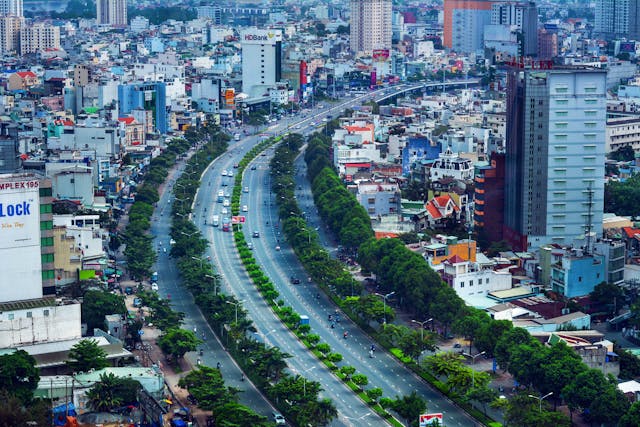
Urbanization has historically been a catalyst for structural transformation. By concentrating firms, workers, infrastructure, and ideas, cities generate agglomeration economies that raise productivity, accelerate innovation, and expand employment opportunities. Higher population density reduces transaction costs, deepens labor market matching, and enables specialization across sectors. In many advanced and emerging economies, urbanization has been tightly associated with industrialization, rising incomes, and poverty reduction.
Africa is the fastest-urbanizing region in the world. Over the next three decades, 800 hundred millions people will be added to its cities, reshaping labor markets, infrastructure demand, and spatial development patterns. Urbanization on the continent is unfolding at relatively low levels of per capita income and industrialization, distinguishing it from historical urban transitions in Europe and East Asia. The central development question is whether African cities will become engines of structural transformation or sites of entrenched poverty, informality and spatial inequality.
Unlike historical urban transitions in Europe and East Asia, Africa’s urbanization has often occurred without commensurate industrial expansion. Manufacturing’s share of employment remains modest in many economies, while services frequently informal absorb the majority of new urban workers. As a result, urban labor markets are dominated by informality, characterized by low earnings, limited social protection, and productivity constraints. The transition from rural to urban areas does not automatically guarantee upward mobility; in many cases, it involves a shift from rural informality to urban informality.
Housing and land markets constitute a major structural constraint. Rapid population growth, weak land governance systems, and limited mortgage financing have produced large informal settlements lacking secure tenure and basic services. High housing costs relative to incomes push low-wage workers to peripheral areas, increasing commuting times and limiting access to employment opportunities. Spatial mismatch between affordable housing and job centers reduces effective labor market participation, particularly for women and youth.
Infrastructure deficits further constrain agglomeration benefits. Congestion, unreliable electricity, inadequate water and sanitation systems, and limited mass transit reduce productivity and raise business costs. Transport investments such as bus rapid transit and light rail systems have demonstrated potential to expand labor market access, but coverage remains limited relative to urban growth rates. Digital infrastructure is improving, yet connectivity gaps persist across secondary cities.
Secondary and intermediary cities represent both a challenge and an opportunity. While megacities attract attention, much of Africa’s future urban growth will occur in smaller cities with weaker fiscal capacity and planning institutions. Strengthening municipal governance, expanding local revenue mobilization, and improving urban planning systems are critical to avoiding uncontrolled sprawl and infrastructure backlogs.
Climate vulnerability compounds these structural pressures. Many African cities are located in coastal or flood-prone areas. Informal settlements are disproportionately exposed to environmental risks, amplifying inequality. Integrating climate resilience into housing, drainage, transport, and land-use planning is essential to safeguarding long-term productivity.
The policy imperative is systemic rather than sectoral. Urban development must align housing policy, labor market institutions, infrastructure finance, and industrial strategy. Supporting small and medium enterprises, simplifying business registration, expanding access to credit, and formalizing property rights can enhance productivity and fiscal capacity. At the same time, social protection systems must adapt to the predominance of informal work.
Several research areas warrant priority attention in the African context:
Urban Informality and Productivity: What policy combinations effectively facilitate transitions from informal to formal employment without undermining livelihoods? How do business environment reforms influence firm growth and wage outcomes?
Housing, Land, and Spatial Mismatch: How do land tenure reforms and affordable housing initiatives affect labor mobility and employment access? What is the productivity impact of improved transport connectivity in rapidly expanding cities?
Secondary Cities and Governance Capacity: How can fiscal decentralization and municipal financing mechanisms strengthen infrastructure provision in fast-growing secondary cities? Do targeted investments in intermediary cities reduce congestion and inequality pressures in megacities?
Africa’s urban transition will shape its development trajectory throughout the twenty-first century. If urban growth is matched with infrastructure expansion, institutional strengthening, and labor market transformation, cities can generate inclusive and sustainable economic dynamism. If not, rapid urbanization risks entrenching spatial inequality and informal employment. The strategic challenge is to convert demographic and spatial expansion into engines of structural transformation.